July, 3, 2026
OSAKI ELECTRIC CO.,LTD.
The OSAKI Group has identified materiality issues as key management priorities to achieve both sustainable enhancement of corporate value and the resolution of social challenges.
The materiality issues originally identified in December 2021 were reviewed in light of changes in the external environment and the Group's business environment. During the review process, the Group reassessed key issues based on their significance and priority while considering the Group's business characteristics, strengths, and potential contributions to society.
When reviewing its materiality framework, the Group recognized the following challenges:
- The relationship between the Group's Purpose, Vision, and Materiality was not always clearly defined.
- The previous framework emphasized comprehensiveness, making the relative significance and priority of issues less clear.
- The framework did not sufficiently reflect issues that are distinctive to the OSAKI Group based on its business characteristics and strengths.
- Materiality was not fully integrated into management strategy and business activities.
- Employee awareness and understanding of materiality required further enhancement.
Based on these challenges, the Group conducted the review with the following objectives:
- Clarify alignment with the Group's Purpose and long-term vision.
- Prioritize issues based on their significance and identify areas requiring focused management attention.
- Reflect the Group's business characteristics, competitive strengths, and key risks and opportunities.
The Sustainability Promotion Committee resolved to initiate the materiality review in May 2025, and the review policy was approved by the Board of Directors in June 2025.
As part of the review process, the Group:
- Reflected stakeholder perspectives, including those of shareholders and investors.
- Conducted discussions through a cross-functional internal project involving mid-career and younger employees.
- Gathered feedback through engagement with external experts.
External Experts Consulted
- Shoichi Tsuburaya, Professor, Graduate School of Business Administration, Hitotsubashi University / Visiting Researcher, Japan Investor Relations Association
- Yuzo Fujishima, Representative Director and Chief Researcher, Listed Company Director Governance Forum Inc.
- Stewardship Promotion Department, Sumitomo Mitsui Trust Asset Management Co., Ltd.
Through dialogue with these external experts, the Group received valuable recommendations, including:
- Demonstrating consistency between materiality and the Group's management philosophy and vision.
- Reflecting the Group's unique characteristics, values, and priorities.
- Clarifying the role of materiality in management.
- Providing a clear explanation of the materiality identification process.
Taking these recommendations into account, the Group restructured its materiality framework so that materiality serves not merely as a list of issues, but as a framework for guiding management decisions and long-term value creation.
In addition, the cross-functional project team established a Vision for 2040 and a Target State for 2030 as milestones toward achieving that vision. Materiality was redefined based on this time horizon, focusing on what is most important and should be prioritized for the future.
As a result, the former materiality framework, which consisted of five materialities and fifteen key issue categories, was reorganized into a three-tier structure comprising:
- Five Materialities
- Eleven Sub-Materialities
- Seventeen Key Initiatives
The new materiality framework was reviewed by the Sustainability Promotion Committee in January 2026 and approved by the Board of Directors in February 2026.
- Creating New Value for Resilient Power Infrastructure
- Contributing to a Decarbonized Society
- Respect for Human Rights
- Creating a Workplace Where Individuals Thrive
- Strengthening Corporate Governance
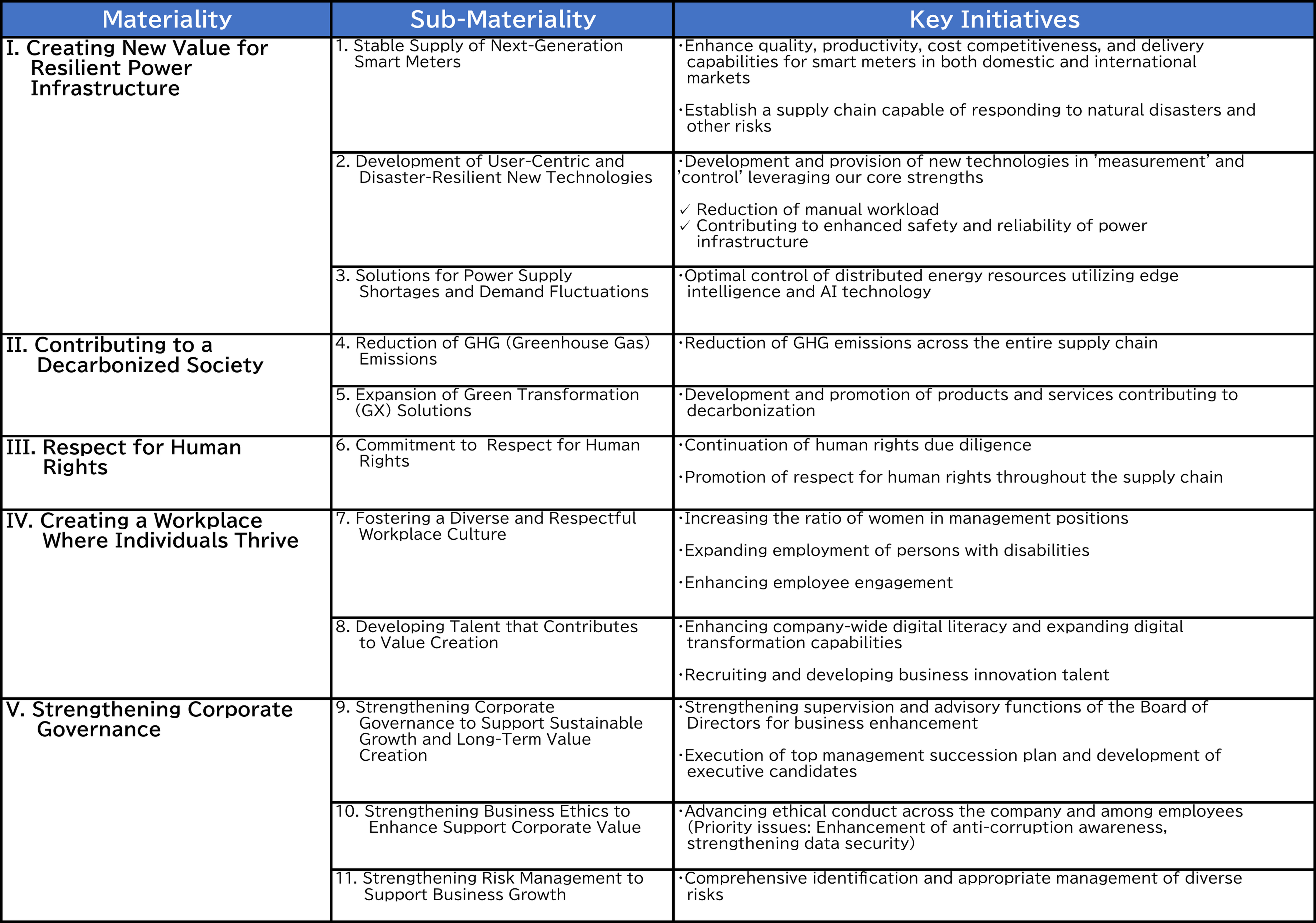
Note: The Group is currently developing short-, medium-, and long-term targets for each of the Key Initiatives outlined above. Following review and approval by the Sustainability Promotion Committee, the proposed targets will be submitted to the Board of Directors for approval. Once finalized, the targets will be disclosed on the Company's website.
Going forward, based on the new materiality framework, the OSAKI Group will establish KPIs (Key Performance Indicators) and short-, medium-, and long-term targets for each Key Initiative to enhance the effectiveness of its efforts. The Group will also monitor progress toward achieving these targets and strengthen disclosure of progress and outcomes to stakeholders.